The Ingredient Library
Thyme (Red)
Thymus vulgaris
Red thyme essential oil is steam-distilled from flowering common thyme, mainly in Spain and southern France, and takes its reddish colour from contact with the still in the first distillation.

Get to know red thyme essential oil
- Source
- Flowering tops
- Origin
- Spain and France
- Extraction
- Steam-distilled
- Aroma
- Warm, spicy, herbal
What it is
Thyme (Red) is an aromatic essential oil distilled from the plant.
Why it belongs in your routine
Strong, warm, spicy oil distilled from flowering thyme in Spain.
How to use
Always dilute in a carrier oil before it touches skin. Never use undiluted. Patch test first.
Where does red thyme essential oil come from?
Common thyme is a low, woody Mediterranean shrub, rarely more than 30 centimetres tall, with tiny grey-green leaves and pale pink to lilac flowers. It grows wild on dry, sunny, stony ground across Spain, southern France and Italy, and it is also cultivated. Like rosemary, it has several chemotypes, and the thymol type is the one most often distilled for red thyme oil.
Red thyme oil is reddish-brown with a strong, warm, spicy, herbal scent. It is high in the phenols thymol and carvacrol, along with para-cymene and gamma-terpinene. The name refers to the crude first distillate: a second distillation gives a paler oil sold as white thyme. Because of its strength it is used at very low levels in soaps, cleaning products and rustic fragrances.
Sourcing & extraction
How red thyme essential oil is sourced and extracted
Why it is rare
Thyme is a small plant with tiny leaves, and much of the Spanish crop is still gathered from wild hillsides. Hundreds of kilograms of flowering herb are needed for a few kilograms of oil, and the thymol content varies with each area and season.
How it is gathered
Spain is the largest source of thyme oil. In regions such as Murcia, Andalusia and Castilla-La Mancha, pickers typically cut the flowering stems of wild thyme by hand or with sickles in late spring and early summer, while some farms grow thyme in rows and cut it by machine. The herb is sometimes dried in the field and then taken to local distilleries, many of them small and run by families.
How it is made
Steam-distilled from flowering herb
- Flowering thyme is cut in late spring or early summer and loaded into a still, fresh or partly dried.
- Steam is passed through the herb, releasing the volatile oil from glands on the leaves and flowers.
- The vapour is cooled and the oil is separated from the water, giving a crude oil that darkens to red-brown.
- This first-run oil is filtered and sold as red thyme, while redistilling it would give the paler white thyme.
How to use red thyme essential oil
- Add a few drops to a diffuser for its aroma.
- For skin, dilute 1 to 2 drops in a teaspoon of carrier oil before applying.
- Keep away from eyes and never use undiluted on skin.
For external use only. Patch test on a small area before first use and stop if irritation occurs. If you are pregnant, nursing or have a medical condition, ask a healthcare professional before use.
From ingredient to routine
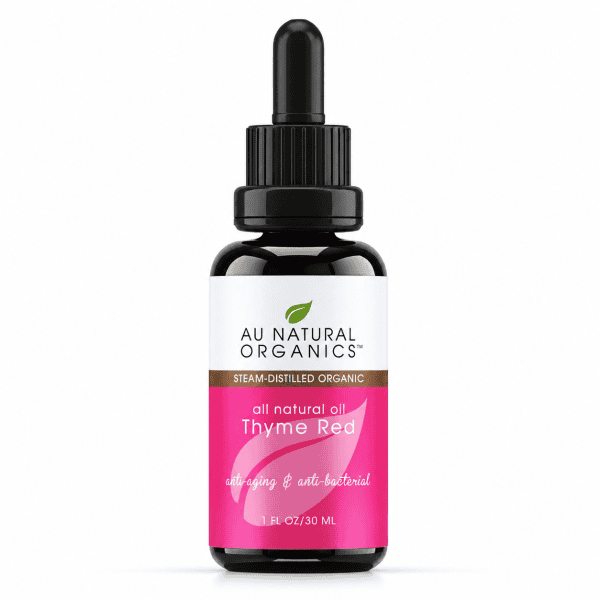
Products with Thyme (Red)
Find this ingredient in our collection.
Questions about Thyme (Red)
Where does Thyme (Red) come from?
Spain is the largest source of thyme oil. In regions such as Murcia, Andalusia and Castilla-La Mancha, pickers typically cut the flowering stems of wild thyme by hand or with sickles in late spring and early summer, while some farms grow thyme in rows and cut it by machine. The herb is sometimes dried in the field and then taken to local distilleries, many of them small and run by families.
How is Thyme (Red) extracted?
Steam-distilled from flowering herb. Flowering thyme is cut in late spring or early summer and loaded into a still, fresh or partly dried. Steam is passed through the herb, releasing the volatile oil from glands on the leaves and flowers. The vapour is cooled and the oil is separated from the water, giving a crude oil that darkens to red-brown. This first-run oil is filtered and sold as red thyme, while redistilling it would give the paler white thyme.
Why is Thyme (Red) considered rare?
Thyme is a small plant with tiny leaves, and much of the Spanish crop is still gathered from wild hillsides. Hundreds of kilograms of flowering herb are needed for a few kilograms of oil, and the thymol content varies with each area and season.