The Ingredient Library
Lavender
Lavandula angustifolia
Lavender essential oil is steam-distilled from the flowering tops of true lavender, grown on the high plateaux of Haute-Provence and in Bulgaria, and cut in a short window each July.
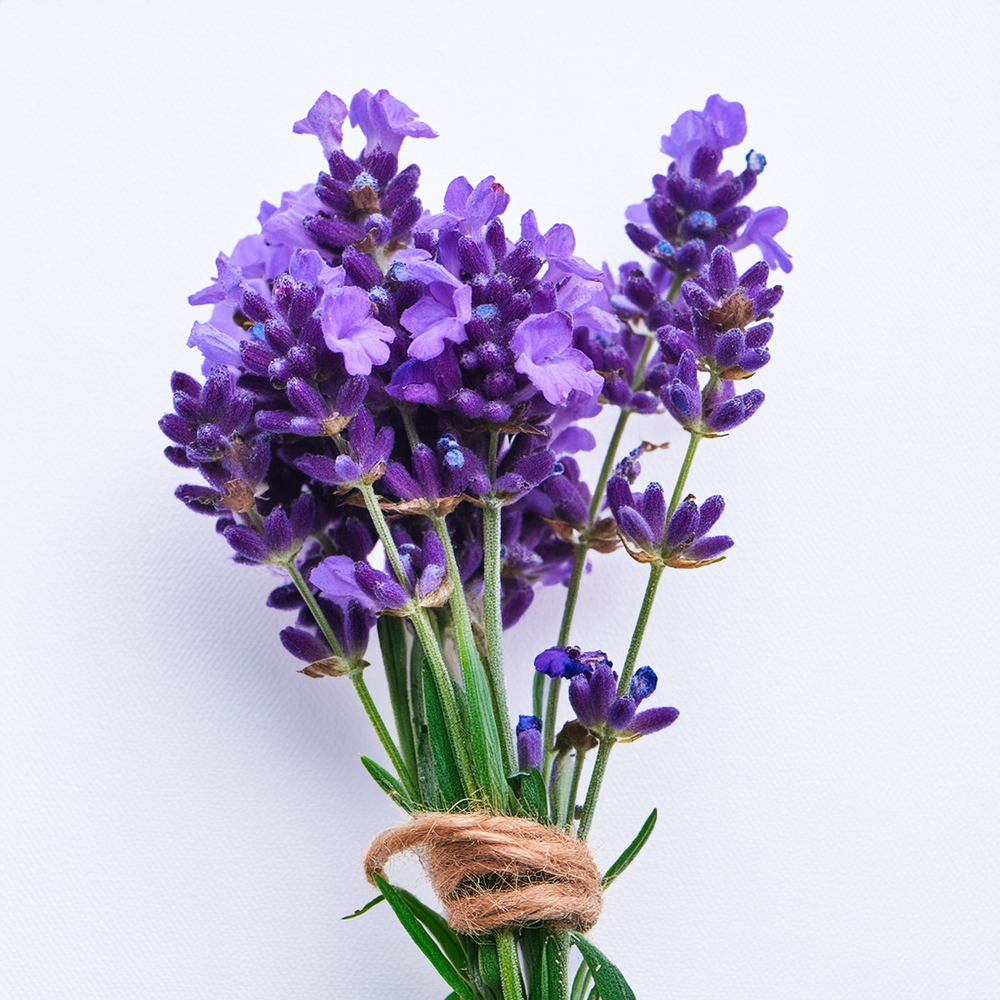
Get to know lavender essential oil
- Source
- Flowering tops
- Origin
- France, Bulgaria
- Extraction
- Steam-distilled
- Aroma
- Floral, herbaceous, sweet
What it is
Lavender is an aromatic essential oil distilled from the plant.
Why it belongs in your routine
True lavender oil, steam-distilled from summer flowering tops.
How to use
Always dilute in a carrier oil before it touches skin. Never use undiluted. Patch test first.
Where does lavender essential oil come from?
True lavender, Lavandula angustifolia, is a small woody shrub from the mountains of the western Mediterranean. It grows about 60 cm tall in neat grey-green mounds and carries slim spikes of violet flowers on long stems. It prefers poor, stony, limey soil and cool nights, which is why the classic fields sit at 600 to 1,400 metres in Haute-Provence. Bulgaria is now the largest producer of lavender oil.
Lavender essential oil is clear to pale yellow, with a sweet, floral, lightly herbaceous scent. Its two main components are linalool and linalyl acetate, and the balance between them shapes the aroma. It is one of the most widely used oils in soap making, bath products, pillow sprays and massage blends, and blends easily with citrus, cedarwood and geranium.
Sourcing & extraction
How lavender essential oil is sourced and extracted
Why it is rare
True lavender yields far less oil than lavandin, its hybrid cousin: roughly 1 kg of oil from 100 to 150 kg of flowering stems. Fields need several years to reach full production and are cut only once a year, in a window of a few weeks.
How it is gathered
Lavender is a farmed crop. In Provence and Bulgaria, growers plant rows of cuttings or seedlings that are harvested from their second or third year. Cutting usually runs from late June to August, when most flowers on the spike are open. Mechanical harvesters take the upper stems, which are either left to wilt in the field for a day or two or taken straight to the still. Many farms run their own distillery or share one with neighbours.
How it is made
Steam-distilled from flowering tops
- Flowering stems are cut in summer when most of the flowers on each spike have opened, usually by mechanical harvester.
- The cut lavender is often left to wilt briefly in the field, then packed tightly into large distillation vats.
- Steam is blown through the plant material for roughly 30 to 60 minutes, releasing the volatile oil from the flower glands.
- The steam and oil vapour are condensed, and the lighter essential oil is drawn off the top of the separator.
- The oil is filtered and left to rest, which lets its scent round out before it is bottled.
How to use lavender essential oil
- Add a few drops to a diffuser for its aroma.
- For skin, dilute 1 to 2 drops in a teaspoon of carrier oil before applying.
- Keep away from eyes and never use undiluted on skin.
For external use only. Patch test on a small area before first use and stop if irritation occurs. If you are pregnant, nursing or have a medical condition, ask a healthcare professional before use.
From ingredient to routine
Products with Lavender
Find this ingredient in our collection.

Questions about Lavender
Where does Lavender come from?
Lavender is a farmed crop. In Provence and Bulgaria, growers plant rows of cuttings or seedlings that are harvested from their second or third year. Cutting usually runs from late June to August, when most flowers on the spike are open. Mechanical harvesters take the upper stems, which are either left to wilt in the field for a day or two or taken straight to the still. Many farms run their own distillery or share one with neighbours.
How is Lavender extracted?
Steam-distilled from flowering tops. Flowering stems are cut in summer when most of the flowers on each spike have opened, usually by mechanical harvester. The cut lavender is often left to wilt briefly in the field, then packed tightly into large distillation vats. Steam is blown through the plant material for roughly 30 to 60 minutes, releasing the volatile oil from the flower glands. The steam and oil vapour are condensed, and the lighter essential oil is drawn off the top of the separator. The oil is filtered and left to rest, which lets its scent round out before it is bottled.
Why is Lavender considered rare?
True lavender yields far less oil than lavandin, its hybrid cousin: roughly 1 kg of oil from 100 to 150 kg of flowering stems. Fields need several years to reach full production and are cut only once a year, in a window of a few weeks.