The Ingredient Library
Black Currant
Ribes nigrum
Black currant seed oil is pressed from the tiny seeds left over when European black currants are made into juice; it is one of the few plant oils to contain gamma-linolenic acid.

Get to know black currant seed oil
- Source
- Seed
- Origin
- Northern Europe
- Extraction
- Cold-pressed or CO2
- Texture
- Light, dry
What it is
Black Currant is a botanical carrier oil used in hair and skin care.
Why it belongs in your routine
Light seed oil from European black currants, containing GLA naturally.
How to use
Warm a few drops between your palms and smooth over hair or skin. Patch test before use.
Where does black currant seed oil come from?
The black currant, Ribes nigrum, is a woody shrub that grows one to two metres tall and is native to cool parts of northern and central Europe and northern Asia. It is widely grown in Poland, the United Kingdom, Scandinavia and Germany. The shrub bears hanging strings of small glossy black berries in midsummer, each holding many tiny seeds, and its leaves and stems have a strong, familiar currant scent.
Black currant seed oil is golden to greenish yellow with a mild, slightly fruity, herbal smell. Linoleic acid is its largest fatty acid, and it naturally contains around 15 to 19 percent gamma-linolenic acid (GLA) and a notable share of alpha-linolenic acid. It feels light and absorbs quickly, so it is used in face oils, serums and light creams.
Sourcing & extraction
How black currant seed oil is sourced and extracted
Why it is rare
Black currant seeds are tiny and are only available as a by-product of juice and cordial making. They must be separated from the pomace and dried soon after pressing, and the finished oil is delicate, so it is made in small batches and needs cool, dark storage.
How it is gathered
Black currants are usually harvested by machine in July and August in the main growing countries of Europe, with Poland among the largest producers. The berries go straight to juice and cordial makers. The pressed pomace of skins and seeds is then dried, and the seeds are sieved out and cleaned. These seeds are sent to specialist oil mills that press them or extract the oil with carbon dioxide.
How it is made
Cold-pressed or CO2-extracted
- Pomace left after juice pressing is dried quickly so the seeds do not spoil.
- The dried pomace is sieved and cleaned to separate the small black currant seeds from the skins.
- The seeds are either cold-pressed in a screw press or extracted with supercritical carbon dioxide.
- The oil is filtered, usually protected with added vitamin E, and bottled away from light and air.
How to use black currant seed oil
- Start with a few drops and warm them between your palms.
- Massage into clean skin, or work through the lengths of damp or dry hair.
- Use on its own, or add a few drops to your moisturizer or conditioner.
For external use only. Patch test on a small area before first use and stop if irritation occurs. If you are pregnant, nursing or have a medical condition, ask a healthcare professional before use.
From ingredient to routine
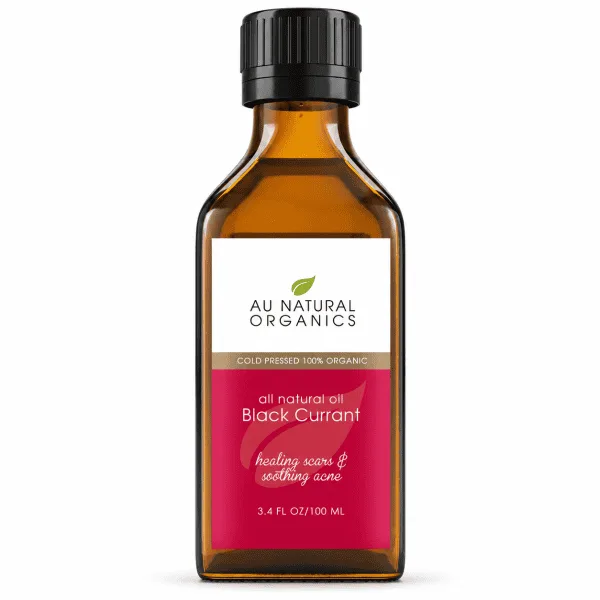
Products with Black Currant
Find this ingredient in our collection.
Questions about Black Currant
Where does Black Currant come from?
Black currants are usually harvested by machine in July and August in the main growing countries of Europe, with Poland among the largest producers. The berries go straight to juice and cordial makers. The pressed pomace of skins and seeds is then dried, and the seeds are sieved out and cleaned. These seeds are sent to specialist oil mills that press them or extract the oil with carbon dioxide.
How is Black Currant extracted?
Cold-pressed or CO2-extracted. Pomace left after juice pressing is dried quickly so the seeds do not spoil. The dried pomace is sieved and cleaned to separate the small black currant seeds from the skins. The seeds are either cold-pressed in a screw press or extracted with supercritical carbon dioxide. The oil is filtered, usually protected with added vitamin E, and bottled away from light and air.
Why is Black Currant considered rare?
Black currant seeds are tiny and are only available as a by-product of juice and cordial making. They must be separated from the pomace and dried soon after pressing, and the finished oil is delicate, so it is made in small batches and needs cool, dark storage.