
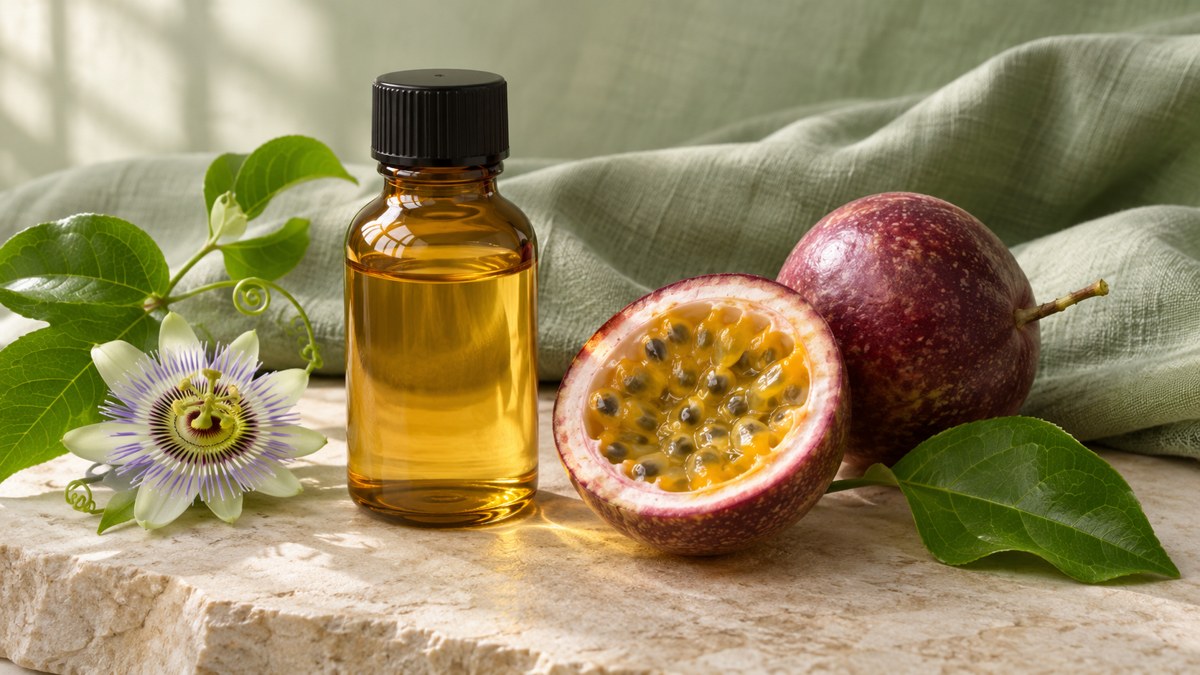
When shoppers compare maracuja oil vs passion fruit oil, they are often looking at the same ingredient. Au Natural Organics uses both names for its oil pressed from Passiflora edulis seeds. A different common name on the front of a bottle does not necessarily mean a different oil inside.
The useful comparison is the full label: botanical identity, plant part, extraction and any additional ingredients. Those details tell you more than the product name alone.
Table of Contents
Why one oil has two names
Maracujá is the Brazilian Portuguese word for passion fruit. It was borrowed from Old Tupi, an Indigenous language of coastal Brazil, and Spanish uses the related form maracuyá. Brazil is a major grower of passion fruit and a source of the seed oil, so the oil often reaches buyers abroad with its Portuguese name still on the label.
The English name comes from the passion flower, a translation of the Latin genus name Passiflora. Christian missionaries in South America chose that name because they read the flower’s parts as religious symbols.
Underneath both common names sits one botanical name, Passiflora edulis, which stays the same in every language. Kew’s Plants of the World Online lists it as an accepted species native from Brazil to Paraguay and northeastern Argentina. Purple-fruited and yellow-fruited passion fruit are both forms of this species, so some labels add f. flavicarpa for the yellow type.
Side-by-side label comparison
Set the two names side by side and the label details line up row for row.
| Label detail | Sold as maracuja oil | Sold as passion fruit seed oil |
|---|---|---|
| Where the name comes from | Brazilian Portuguese, from Old Tupi | English, from the passion flower |
| Botanical name | Passiflora edulis | Passiflora edulis |
| Plant part | Seed | Seed |
| INCI name on the ingredient list | Passiflora Edulis Seed Oil | Passiflora Edulis Seed Oil |
| Usual extraction | Cold-pressed or expeller-pressed | Cold-pressed or expeller-pressed |
| What can still differ | Refining, added fragrance, blends | Refining, added fragrance, blends |
Any real difference sits in the rows a common name cannot cover: refining, added fragrance, other oils in a blend, or a different plant part. The same plant-part question decides sea buckthorn berry oil vs seed oil, where one shrub gives two oils with different labels.
What the store’s product contains
The current passion fruit seed oil listing identifies 100% Passiflora edulis seed oil, cold-pressed in Brazil. The page describes a light, dry, silky feel and a faint fruity scent.
This is a seed oil for topical cosmetic use. It is different from fruit juice, a passion fruit extract or a fragranced product carrying a similar name. Those formats may contain different materials and have different directions.
Maracuja oil vs passion fruit oil: four label checks
- Find the botanical name. For the product discussed here, look for Passiflora edulis rather than relying only on maracuja or passion fruit.
- Check the plant part. A seed oil tells you which material was used; a fruit extract is a different description.
- Read the entire ingredient list. A product featuring maracuja may be a blend instead of a single-ingredient oil.
- Compare directions and processing information. Follow the instructions for the finished product you buy, even if another bottle uses the same common name.
You do not need to buy two oils simply because one says maracuja and another says passion fruit. First establish whether the ingredients actually differ.
Choose by the routine you want
For skin, the store’s directions suggest two to three drops pressed into damp skin. For body use, they suggest a small amount after a shower. For hair, the directions describe a few drops over the lengths.
Choose one use to assess first. Spread a modest amount, let the finish settle, and adjust on a later application if necessary. Keeping the rest of your routine consistent helps you decide whether you enjoy this particular oil.
If you are comparing pure oil with a serum, consider the whole formula. The serum’s feel and scent may come from several ingredients, so the name of its featured botanical is only part of the story.
If you are choosing between two different oils rather than two names for one, the jojoba oil vs argan oil and tamanu oil vs rosehip oil comparisons cover texture, scent and use.
What the name cannot promise
Neither common name establishes an organic certification, a particular result or suitability for every person. Look for specific supporting information when a claim matters to your buying decision.
Likewise, descriptions such as light or dry refer to cosmetic feel. They do not mean you should expect the same experience at every amount or when layering with every moisturizer.
The passion fruit ingredient guide provides more background on the store’s botanical source.
Quick questions
Is maracuja oil a separate essential oil?
The product discussed here is a carrier seed oil. Do not use essential-oil instructions simply because a product has a botanical name.
Can I expect a strong passion fruit perfume?
The listing describes a faint fruity scent. A strongly fragranced product may have a different formula; check its ingredients.
How should I introduce it?
Read the label, try a small area before first use, avoid the eyes and stop if irritation occurs. Store it cool and dark with the cap closed.
In the maracuja oil vs passion fruit oil question, the label settles more than the name. View the current passion fruit seed oil label details to compare the ingredient rather than choosing by the name alone.

Leave a comment
You must be logged in to post a comment.