
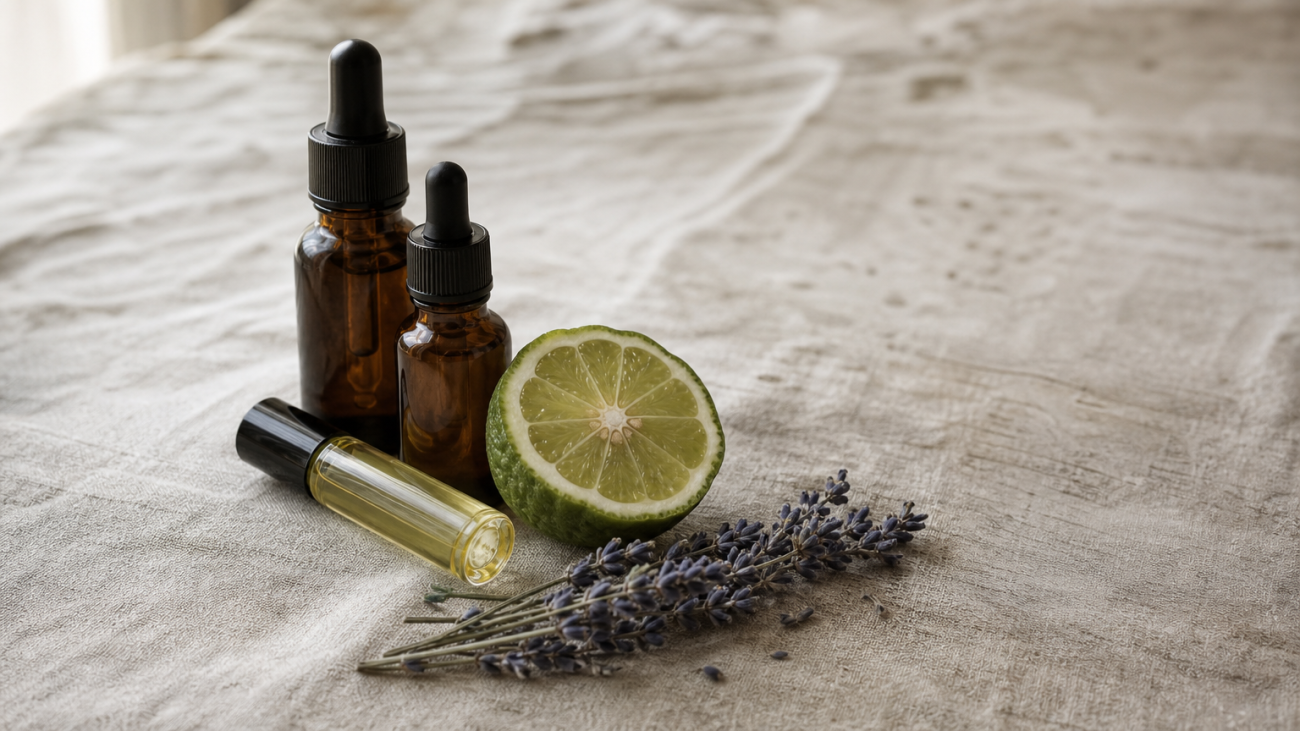
If you want to make a natural scent, the oils you pick matter more than any recipe. The best essential oils in perfume do two jobs at once. They smell good, and they last long enough on skin to be worth wearing. Most beginners grab a few favorites, mix them at random, and end up with a scent that fades in an hour or turns muddy.
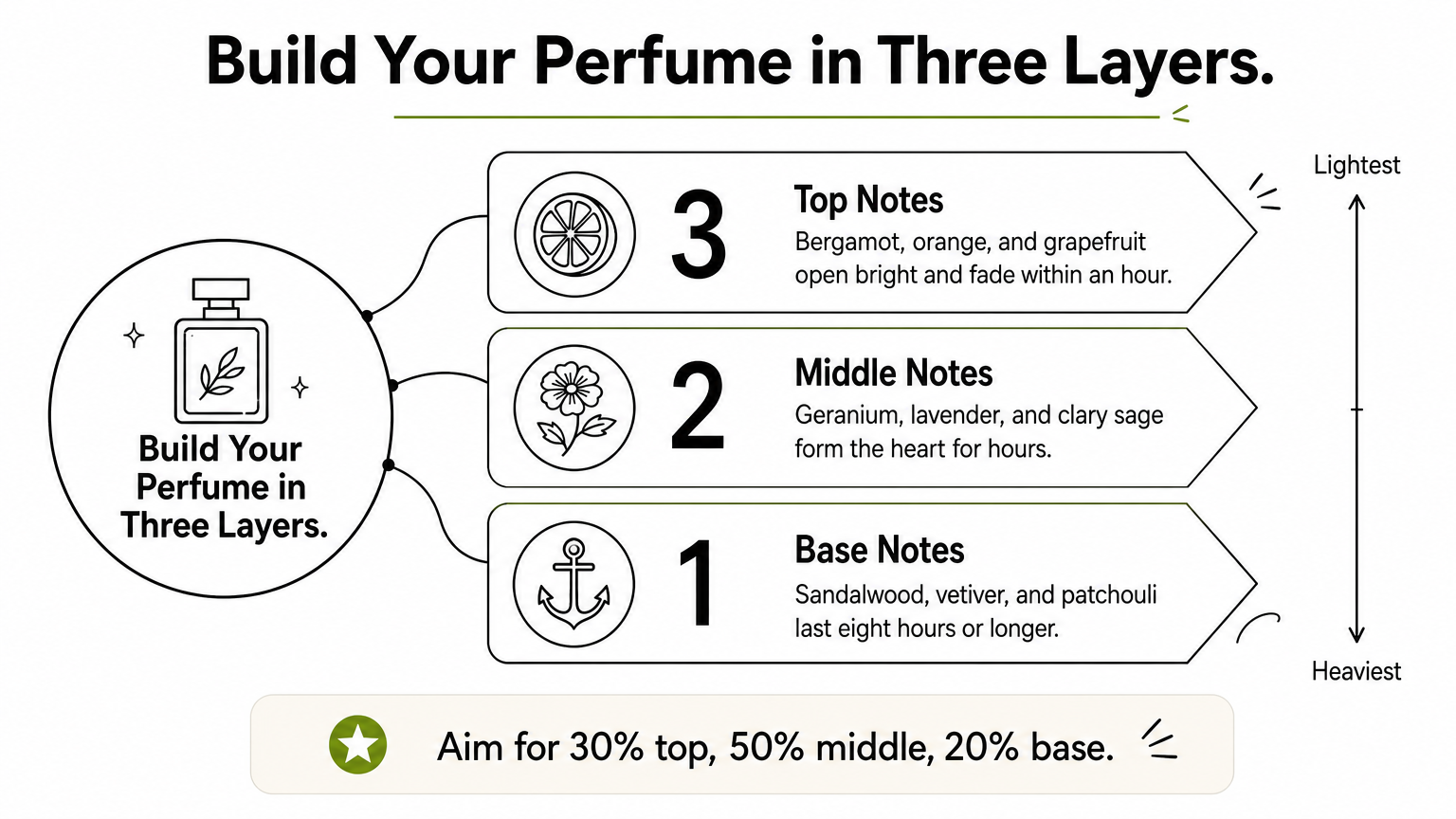
The fix is understanding structure. Every blend needs top, middle, and base notes. Citrus and bergamot open bright and vanish fast. Lavender, rose, and geranium form the heart. Sandalwood, patchouli, and vetiver anchor everything and slow the fade. Pure essential oils can replace synthetic fragrance completely, as long as you balance those three layers and dilute them properly in a carrier oil.
Below, you will find 12 essential oils that earn a place in a natural perfume, with each one’s note, scent profile, and best pairings. We also cover simple ratios to start with. At Au Natural Organics, we source raw, unrefined botanicals and carrier oils with clear origins, so you can build a blend you actually trust on your skin.
1. Bergamot
Scent and note position
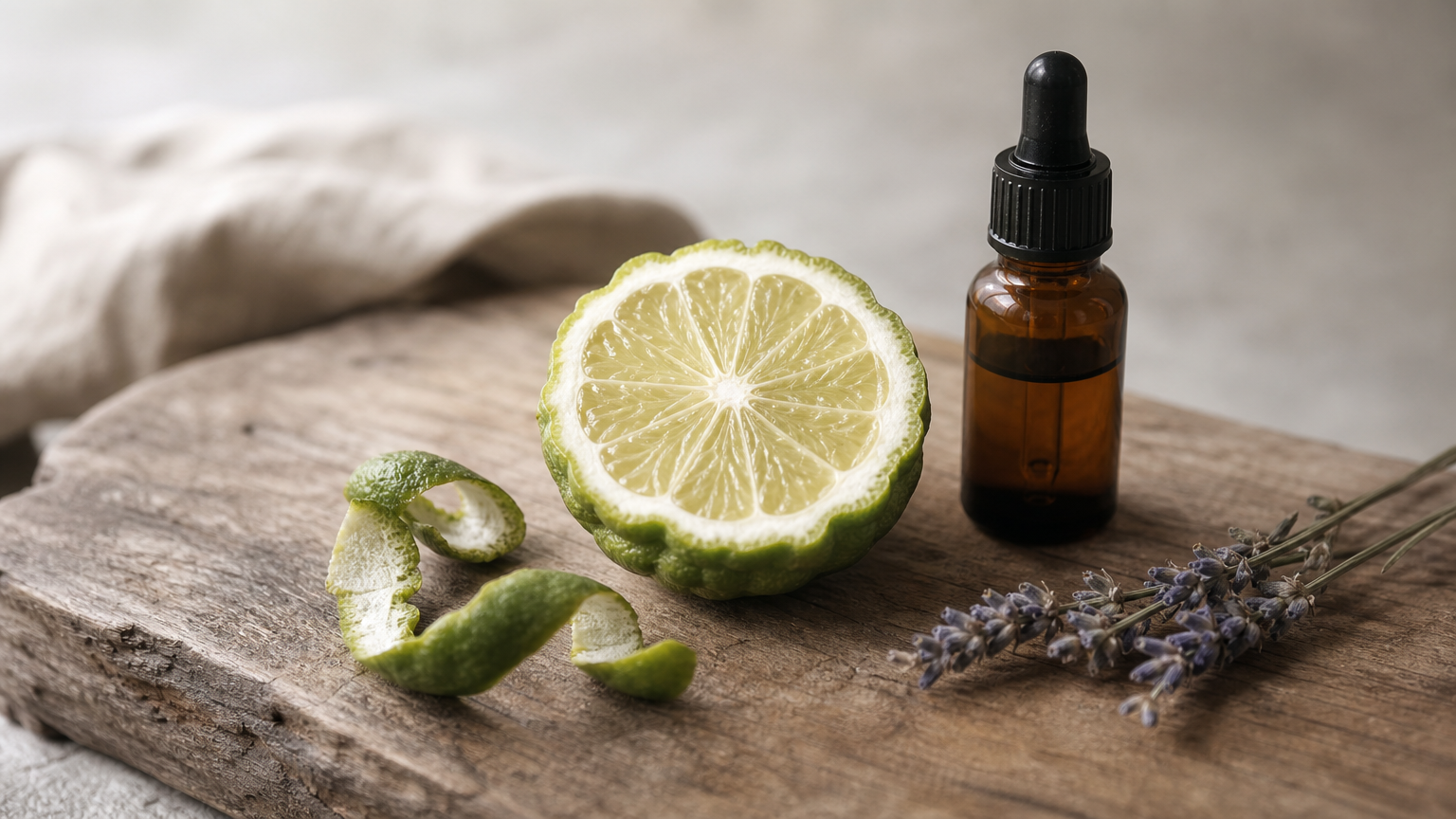
Bergamot is the oil most perfumers reach for first. It smells like sparkling citrus with a floral, slightly spicy edge, softer and more rounded than lemon or orange. The oil is pressed from the peel of a citrus fruit grown mostly in Calabria, Italy, and it is the signature opening of classic colognes and Earl Grey tea.
That short life is not a flaw. As a top note, bergamot fades within 30 to 60 minutes, and its job is the first impression. Among the essential oils in perfume, it is the one that makes a blend smell fresh the moment you open the bottle.
Best blending partners
Bergamot is a team player. It lifts heavy oils and softens sharp ones, so it works in almost any natural fragrance you build. These pairings are the most reliable:
- Lavender: a clean, herbal combination that suits beginners.
- Geranium: adds a rosy heart under the citrus.
- Sandalwood or vetiver: gives the fleeting top note a base to rest on.
- Jasmine: turns bright citrus into something warm and floral.
How to use it in a blend
Safety comes first. Cold-pressed bergamot is phototoxic, meaning it can cause burns or dark patches when skin meets sunlight. The IFRA limit for leave-on products is 0.4%, so either keep it under that level or buy bergapten-free (FCF) bergamot. Skip sun exposure on the scented area for 12 hours if you use the regular oil.
Bergamot opens the blend, but it needs a base note to hold it in place.
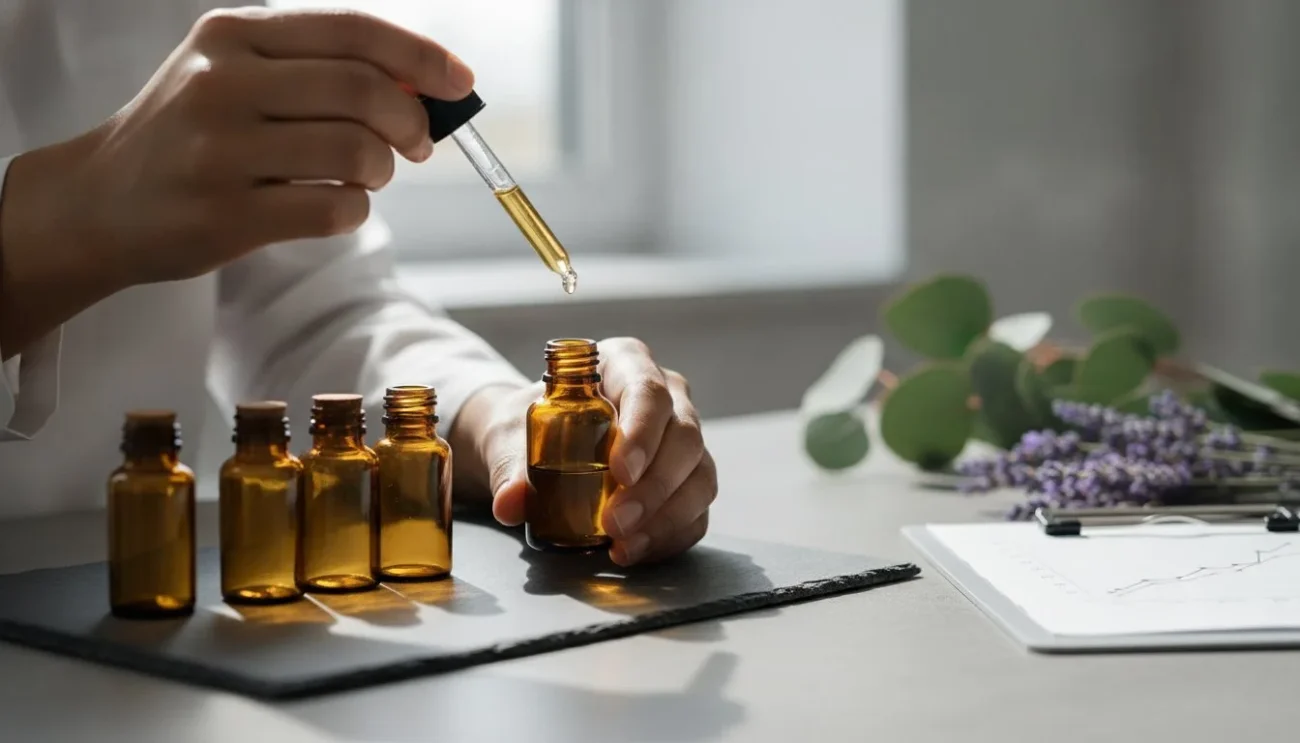
For a simple starter, build on a ratio of roughly 30% top, 50% middle, and 20% base notes, then dilute the finished mix in a carrier oil. Use bergamot as your top note, add geranium for the middle, and finish with sandalwood. Let the blend rest for 48 hours before you judge it, since the oils need time to marry. Apply it to pulse points, and reapply the citrus top after a few hours if you want that bright opening back.
2. Sweet orange
Scent and note position
Sweet orange smells like a freshly peeled orange, juicy and sunny, without the sharp bite of lemon. It is cold-pressed from the rind and is one of the most affordable essential oils for perfumes. As a top note, it fades in 30 to 45 minutes, so treat it as the cheerful opening, not the lasting scent.
Best blending partners
Orange softens heavy oils and makes them easier to wear. It pairs best with warm, woody, or herbal oils that give it something to lean on. These matches work reliably:
- Cedarwood: dry and woody, it grounds the sweetness.
- Lavender: a soft, herbal blend with a fresh finish.
- Ylang ylang: creamy and floral, with a tropical feel.
- Patchouli: earthy depth that stops orange smelling like candy.
- Clary sage: smooth, slightly musky, and a little sophisticated.
How to use it in a blend
Expect a gentler oil than bergamot. Sweet orange is generally not considered phototoxic, but it oxidizes fast, so store it cool, dark, and tightly capped and replace it after about a year. Oxidized citrus oil is a common cause of skin irritation.
Sweet orange adds cheer to a blend, but it needs a woody partner to stay on the skin.
Try this 10 ml roller, which comes to roughly a 9% dilution:
- 8 drops sweet orange
- 6 drops cedarwood
- 4 drops lavender
- Fill the rest with jojoba oil
Let it rest for 48 hours, then test it on your inner wrist. If the orange fades too quickly, add one more drop of cedarwood.
3. Grapefruit
Scent and note position
Grapefruit smells tart, juicy, and slightly bitter, with a green snap that sweet orange lacks. It is cold-pressed from the peel and gives a blend a clean, modern opening. Like the other citrus oils, it is a top note and fades in about 30 to 45 minutes.
That sharpness is why many people choose it among essential oils for fragrance when they find orange too sweet. It wakes up a blend without turning it into candy.
Best blending partners
Grapefruit needs earthy or floral oils to balance its bite. These pairings work best:
- Vetiver: a smoky, green base that anchors the citrus.
- Geranium: rounds the bitterness with a soft rose note.
- Cedarwood: dry and woody, it adds staying power.
- Bergamot: layers two citrus tones for a fuller opening.
How to use it in a blend
Cold-pressed grapefruit is mildly phototoxic, with a commonly cited leave-on limit of about 4%. A normal perfume dilution stays well below that, but still avoid strong sun on the area. It also oxidizes quickly, so keep the bottle cool, dark, and tightly capped.
Grapefruit gives a blend its sparkle, but vetiver or cedarwood keeps that sparkle on your skin.
Try this 10 ml roller, roughly a 5% dilution:
- 4 drops grapefruit
- 3 drops geranium
- 3 drops vetiver
- Fill the rest with jojoba oil
Let it rest for 48 hours before testing on your wrist.
4. Lavender
Scent and note position
Lavender smells clean, floral, and herbal, with a soft, slightly sweet woodiness underneath. It is steam-distilled from the flower spikes. Most perfumers choose true lavender (Lavandula angustifolia) over lavandin, which smells sharper and more camphor-like.
Technically it sits between the top and middle notes. It shows up early, then lingers for a couple of hours. That makes it the bridge in many blends, and one of the easiest essential oils for perfumery to work with.
Best blending partners
Almost nothing clashes with lavender, so it is a safe anchor for perfume from essential oils when you are still learning. It also rounds off sharp citrus without dulling it. These pairings work best:
- Bergamot: the classic fresh, cologne-style pair.
- Cedarwood: dry and woody, it deepens the herbal side.
- Clary sage: both oils share a smooth, slightly musky quality.
- Patchouli: a small amount adds earthy depth.
How to use it in a blend
Safety is simple here. Properly diluted lavender is gentle on most skin and is not phototoxic, so it suits daytime wear. The real risk is overdoing it. Too much turns a perfume into a linen spray, so keep it to about a third of your drops.
Lavender ties a blend together, but only when it stays in the supporting role.
Try this 10 ml roller, roughly a 6% dilution:
- 6 drops lavender
- 3 drops cedarwood
- 3 drops sweet orange
- Fill the rest with jojoba oil
Let it rest for 48 hours, then test it on your inner wrist before you commit to a full bottle.
5. Geranium
Scent and note position
Geranium smells like rose with a green, slightly minty edge. It is steam-distilled from the leaves and stems of Pelargonium graveolens, and many perfumers use it as an affordable stand-in for rose oil.
As a middle note, it lasts roughly two to four hours and forms the floral heart of a blend. Among the essential oils in perfume, it is one of the best at smoothing the jump from a bright top to a deep base.
Best blending partners
Few oils get along with citrus, woods, and herbs as easily, which is why geranium anchors so many essential oils as perfume blends. It also softens sharp top notes without hiding them. The best matches:
- Bergamot: a rosy heart under bright citrus.
- Sandalwood: creamy wood that smooths the green edge.
- Patchouli: earthy depth that makes the rose smell richer.
- Lavender: a calm, herbal floral pairing.
How to use it in a blend
Unlike citrus, geranium is not phototoxic, so it suits daytime wear. Some people do react to it, so patch test a diluted drop on your inner arm first. Go light, because too much turns sharp and soapy.
Geranium is the heart of the blend, so give it room without letting it take over.
Try this 10 ml roller, roughly a 5% dilution:
- 5 drops geranium
- 3 drops bergamot FCF
- 2 drops sandalwood
- Fill the rest with jojoba oil
Let it rest for 48 hours before you test it on your wrist.
6. Ylang ylang
Scent and note position
Ylang ylang smells sweet, creamy, and intensely floral, with a hint of banana custard and spice. It is steam-distilled from the flowers of Cananga odorata, grown mostly in Madagascar, the Comoros, and Indonesia.
Labels read extra, I, II, or III. These are fractions collected at different points of the distillation. Extra is the richest grade, and it sits between the middle and base notes, lasting about three to five hours.
Best blending partners
Strong florals need contrast. Ylang ylang works best with bright citrus or dry woods that cut its sweetness. These pairings work reliably:
- Bergamot: fresh citrus keeps the flower from feeling heavy.
- Sandalwood: creamy wood that matches its softness.
- Cedarwood: a dry backbone against the sugar.
- Sweet orange: a sunny, tropical combination.
How to use it in a blend
Potency is the main issue. Among pure essential oils for perfume, this one overwhelms a blend fast, and too much can cause headaches or nausea. Safety references commonly cap leave-on use near 0.8%, so one drop in a 10 ml roller (about 0.5%) is plenty.
With ylang ylang, one drop is a perfume and three drops is a headache.
Try this 10 ml roller, roughly a 4% dilution:
- 1 drop ylang ylang
- 4 drops bergamot FCF
- 3 drops sandalwood
- Fill the rest with jojoba oil
Let it rest for 48 hours, then patch test on your inner arm before wearing it.
7. Jasmine
Scent and note position
Jasmine smells rich, warm, and honeyed, with a heady white-floral sweetness and a faint fruity depth underneath. It is usually sold as an absolute, extracted with solvents from Jasminum grandiflorum or Jasminum sambac flowers grown in India, Egypt, and France. The blossoms are picked at night, when their scent peaks.
Technically it is a middle note, but it lingers six hours or more and behaves like a base. If you want essential oils as fragrance with real presence, jasmine is the closest thing to a signature floral.
Best blending partners
Because it is so strong, jasmine needs fresh or woody oils to keep it from turning cloying. Used well, it also adds warmth and romance to simple blends. These pairings work best:
- Bergamot: bright citrus that lifts the sweetness.
- Sandalwood: creamy wood that extends the floral.
- Geranium: a green rose note that adds balance.
- Clary sage: a smooth, musky partner for evening wear.
How to use it in a blend
Price is the first hurdle. Pure jasmine absolute can cost hundreds of dollars per ounce, so most buyers choose a pre-diluted version in jojoba, often 5% to 10%. It is also a known skin sensitizer, so patch test before you wear it.
Jasmine is a luxury ingredient, so a few drops of a diluted oil go a long way.
Try this 10 ml roller, roughly a 7% dilution, using a 10% jasmine dilution:
- 6 drops jasmine (10% dilution)
- 4 drops bergamot FCF
- 3 drops sandalwood
- 2 drops geranium
- Fill the rest with jojoba oil
Let it rest for 48 hours, then test it on your inner wrist.
8. Clary sage
Scent and note position
Clary sage smells herbal, nutty, and softly musky, with a hay-like sweetness and a hint of wine. It is steam-distilled from the flowering tops of Salvia sclarea, grown in France, Russia, and the United States.
Perfumers value it as a middle note that lasts about three to five hours. It adds a smooth, almost ambergris-like depth that florals alone lack, so a single drop rounds out a blend without announcing itself.
Best blending partners
Citrus and woods both flatter clary sage, which makes it a quiet connector between layers. These pairings work best:
- Bergamot: bright citrus that lifts the earthy musk.
- Lavender: a calm herbal match, since the two share a family resemblance.
- Sandalwood: creamy wood that deepens the musky side.
- Jasmine: a smooth, sultry combination for evening wear.
How to use it in a blend
Safety matters with this one. Clary sage is not phototoxic, but it can cause drowsiness, and it is commonly advised to avoid during pregnancy. Skip it before driving if you are sensitive to it.
Clary sage is the blender in a perfume, smoothing the seams between your top and base notes.
Try this 10 ml roller, roughly a 5% dilution:
- 4 drops clary sage
- 3 drops bergamot FCF
- 2 drops lavender
- 1 drop sandalwood
- Fill the rest with jojoba oil
Let it rest for 48 hours, then patch test on your inner arm. It makes a soft, understated choice if you want essential oils instead of perfume for everyday wear.
9. Sandalwood
Scent and note position
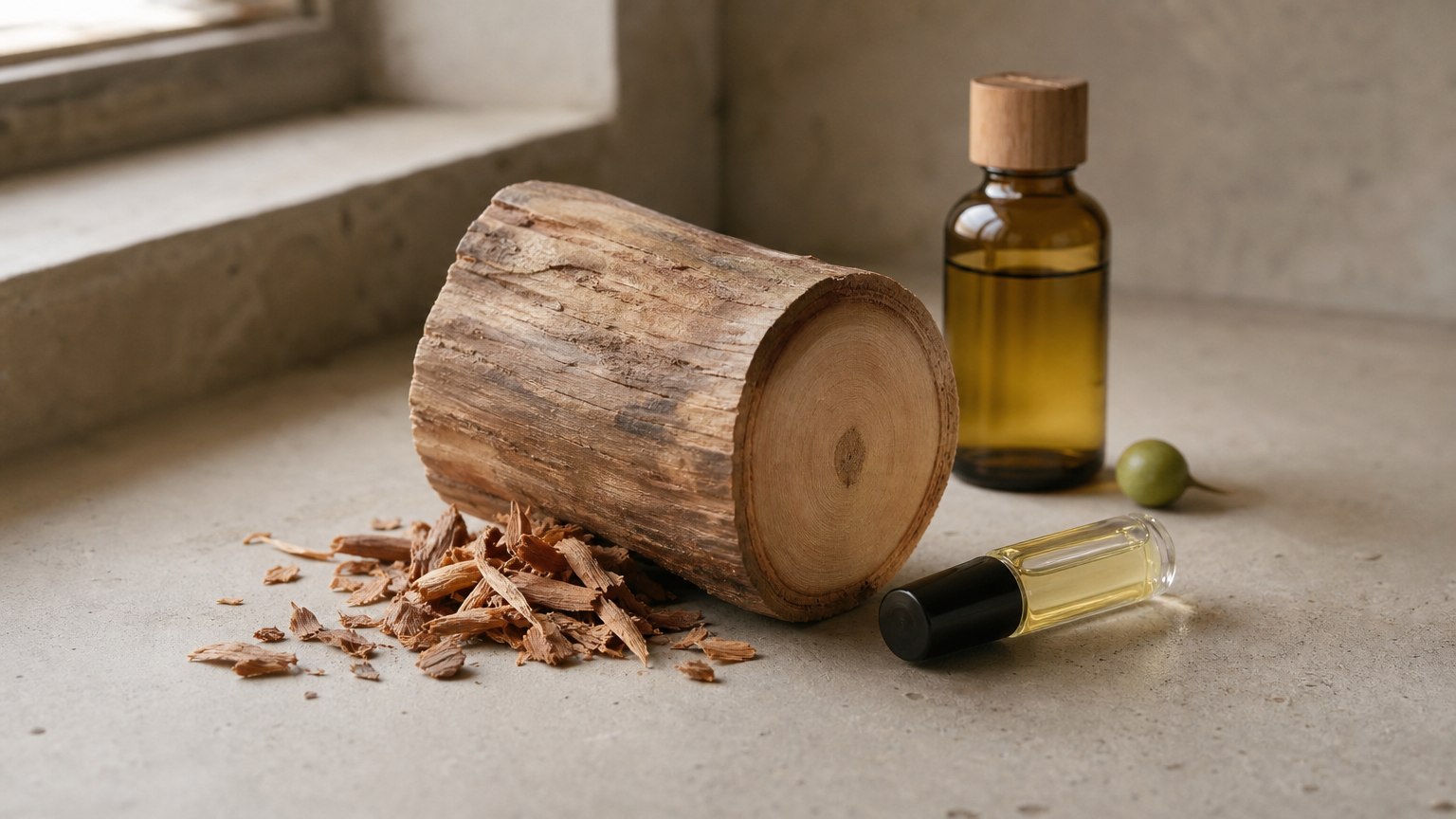
Sandalwood smells creamy, soft, and gently sweet, with a warm woodiness and a milky finish. It is steam-distilled from the heartwood of Santalum album (India) or Santalum spicatum (Australia). As a base note, it lasts eight hours or more. That makes it the fixative that holds brighter oils in place, which is why you find it so often among the essential oils in perfumes.
Best blending partners
Almost every floral and citrus oil sits well on top of sandalwood’s smooth base. It also softens sharp edges without adding any of its own. These pairings work best:
- Bergamot: bright citrus resting on creamy wood.
- Geranium: smooths the green edge of the rose.
- Ylang ylang: a lush, tropical match for its softness.
- Jasmine: extends the floral for hours.
How to use it in a blend
Sourcing is the main issue. Indian sandalwood is overharvested and expensive, so look for Australian or sustainably sourced oil and check that the label lists the Latin name. A very cheap bottle is often diluted or adulterated, so it will not anchor anything.
Sandalwood is the anchor of a natural perfume, so buy it for staying power and check the species on the label.
Skin tolerates it well, but patch test anyway. Try this 10 ml roller, roughly a 5% dilution:
- 4 drops sandalwood
- 3 drops bergamot FCF
- 3 drops lavender
- Fill the rest with jojoba oil
Let it rest for 48 hours, then test it on your inner wrist.
10. Cedarwood
Scent and note position
Cedarwood smells dry, woody, and slightly sweet, like fresh pencil shavings with a soft balsamic warmth. It is steam-distilled from wood chips and sawdust. Atlas cedarwood (Cedrus atlantica) comes from Morocco and smells rounder. Virginia cedarwood (Juniperus virginiana) from the United States is sharper and drier.
As a base note, it lasts six hours or more. That staying power makes it a practical, budget-friendly alternative to sandalwood when you want essential oils for perfume that anchor a blend.
Best blending partners
Cedarwood grounds almost anything, so it suits bright citrus and herbal oils that need some weight. These pairings work best:
- Sweet orange: sunny sweetness on a dry backbone.
- Grapefruit: a crisp, modern opening over warm wood.
- Lavender: a classic herbal and woody match.
- Clary sage: smooth and musky, with a softer finish.
How to use it in a blend
Safety is straightforward. Cedarwood is not phototoxic, but it is commonly advised to avoid during pregnancy, and you should patch test a diluted drop first. Go easy, because too much smells like a pencil box.
Cedarwood is the quiet base of a blend, so use it to give fleeting citrus something to stand on.
Try this 10 ml roller, roughly a 5% dilution:
- 4 drops cedarwood
- 3 drops grapefruit
- 2 drops lavender
- 1 drop clary sage
- Fill the rest with jojoba oil
Let it rest for 48 hours, then test it on your inner wrist.
11. Vetiver
Scent and note position
Vetiver smells earthy, smoky, and green, like damp soil after rain with a faint sweetness. It is steam-distilled from the roots of Chrysopogon zizanioides, a tall grass grown in Haiti, India, and Indonesia.
As a base note, it lasts a full day and longer on fabric. Among the essential oils in perfume, it is one of the strongest fixatives. The oil is thick and amber, so warm the bottle in your hands before you pour.
Best blending partners
Rich earth needs brightness or flowers on top, or the blend turns heavy. These pairings work best:
- Grapefruit: a crisp, bitter-green opening over smoky roots.
- Bergamot: fresh citrus that lifts the earthiness.
- Geranium: a rosy heart that softens the smoke.
- Lavender: a herbal bridge for essential oils as perfumes with a masculine, cologne-style feel.
How to use it in a blend
Skin generally tolerates vetiver well, and it is not phototoxic. Still, patch test a diluted drop first. Go light, because too much smells like a muddy garden.
Vetiver is the anchor that makes a fleeting citrus blend last all day.
Try this 10 ml roller, roughly a 5% dilution:
- 3 drops vetiver
- 3 drops bergamot FCF
- 2 drops geranium
- 2 drops lavender
- Fill the rest with jojoba oil
Let it rest for 48 hours. Vetiver improves with time, so the blend will smell smoother after a week.
12. Patchouli
Scent and note position
Patchouli smells deep, earthy, and sweetly musty, with cocoa-like and faintly camphorous undertones. It comes from the leaves of Pogostemon cablin, which are dried, fermented, and steam-distilled. Most oil comes from Indonesia and India.
As a base note, it lasts a day or longer on skin. Among the essential oils in perfume, it is the one that improves most with age, so an older bottle often smells smoother and richer than a fresh one.
Best blending partners
Heavy earth needs light or floral company, or it takes over. Patchouli also gives bright oils a depth they lack on their own. These pairings work best:
- Sweet orange: keeps the sweetness from smelling like candy.
- Geranium: makes the rose note richer.
- Bergamot: fresh citrus that lifts the earthiness.
- Clary sage: a smooth, musky match for evening wear.
How to use it in a blend
Skin tolerates patchouli well, and it is not phototoxic. Strength is the real issue, because too much turns musty and overpowering. Start with a few drops and add more only after the blend has rested.
Patchouli is the deep end of a blend, so use a little and let it age.
Try this 10 ml roller, roughly a 5% dilution:
- 3 drops patchouli
- 3 drops sweet orange
- 2 drops geranium
- 2 drops clary sage
- Fill the rest with jojoba oil
Let it rest for 48 hours, then patch test on your inner arm. Give it a week if you can, since the patchouli mellows and blends in with time.
Putting your natural perfume together
The best essential oils in perfume work as a team. Pick one top note like bergamot, one heart note like geranium or lavender, and one base note like sandalwood or vetiver. Keep the ratio near 30/50/20, dilute everything in jojoba, and let the blend rest for 48 hours before you judge it.
Start small, because a 10 ml roller costs little and teaches you a lot. Patch test every new oil, watch the phototoxic citrus, and adjust one drop at a time. Quality decides the result, so buy oils with clear origins and the Latin name on the label.
Ready to build your first blend? Browse our pure essential oils and raw, unrefined botanicals at Au Natural Organics and pick up a carrier oil plus your three favorite notes.

Leave a comment
You must be logged in to post a comment.