
The term “therapeutic grade” is a calculated marketing invention. It is a trademarked label designed to manufacture trust where transparency should exist. You are right to be skeptical of the crowded digital marketplace and the “clean-label” claims that often mask synthetic adulteration. Identifying the best organic essential oils brands requires looking past the branding and into the chemical fingerprints of the plants themselves.
We understand the frustration of seeking purity in an industry that grew to a 28 billion dollar market in 2025 by often prioritizing profit over botanical integrity. This guide provides an authoritative framework for vetting suppliers based on current USDA organic standards and batch-specific testing. You will discover how to verify 100% pure oils and understand the direct link between ethical sourcing and therapeutic efficacy. We are cutting through the noise to highlight the masters of the craft who refuse to compromise on quality. This is a definitive guide for those who value substance over style.
Key Takeaways
- Distinguish between unregulated marketing claims and the rigorous legal standards of USDA organic certification to ensure botanical integrity.
- Navigate the complexities of GC/MS testing to detect synthetic markers. This allows you to confirm the authentic chemical profile of every bottle.
- Review an expert-vetted list of the best organic essential oils brands that prioritize small-batch production and ethical, global sourcing.
- Learn to spot deceptive industry practices. We identify red flags like fixed pricing structures and the misuse of “fragrance oils” in place of genuine plant extracts.
- Gain a clear framework for integrating rare botanicals into your regimen with absolute confidence in their origin and purity.
Defining Purity: What Makes an Essential Oil Brand the ‘Best’?
Quality is not a preference. It is a verifiable standard. When searching for the best organic essential oils brands, the focus must shift from how an oil smells to how it was born. Purity is the intersection of radical transparency, rigorous laboratory testing, and unwavering botanical integrity. It’s the difference between a product that merely mimics a scent and one that delivers true physiological results.
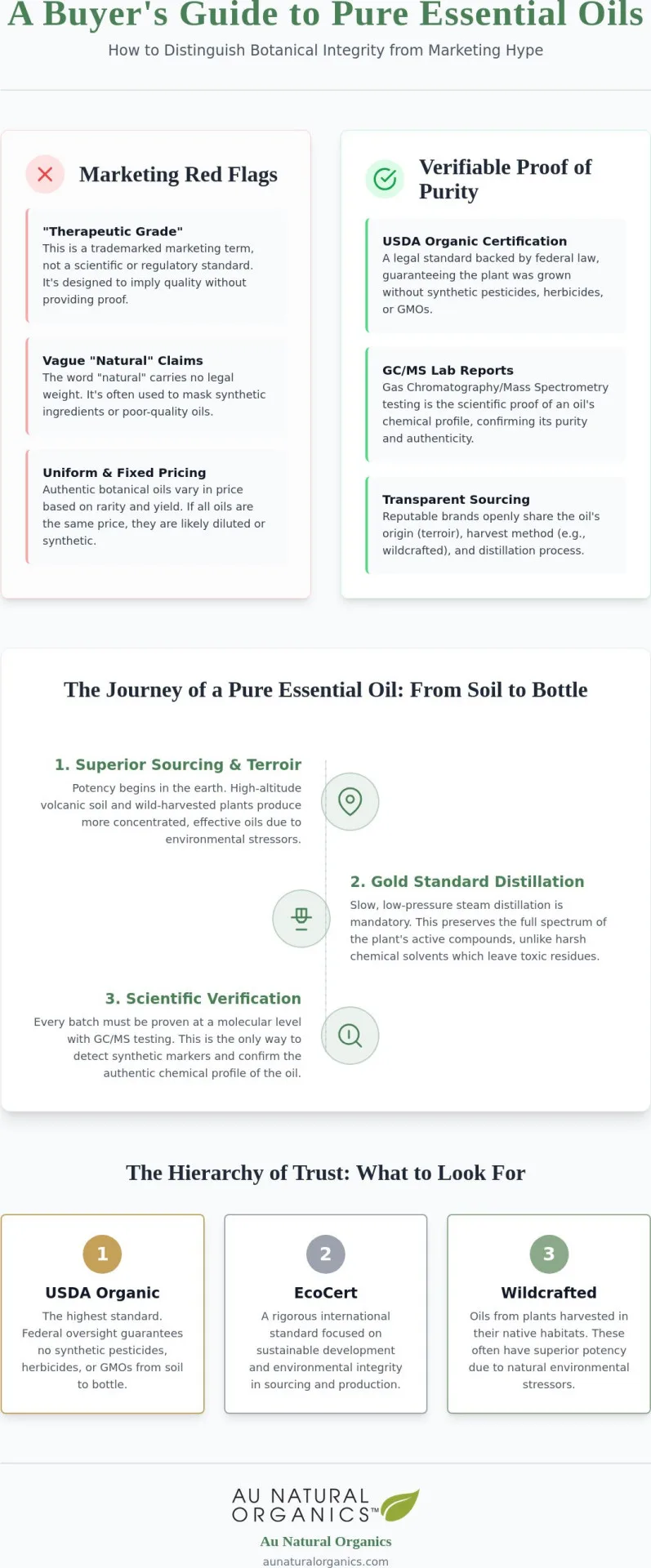
The word “natural” is often used as a shield for mediocrity. It carries no legal weight and requires no proof. In contrast, “Organic” is a regulatory standard backed by federal law. As of July 2026, the USDA has tightened its National List of Allowed and Prohibited Substances, reinforcing the barrier between genuine organic production and industrial shortcuts. A certified organic label ensures that the plant lived in soil free from synthetic pesticides, herbicides, and artificial fertilizers for a minimum of three years. Identifying the best organic essential oils brands requires this commitment to sourcing that goes beyond the surface level.
We prioritize botanical integrity over marketing trends. This metric evaluates whether the final oil retains the complete chemical profile of the living plant. Mass-market producers often treat botanicals like raw commodities, using high-pressure systems to force yield at the expense of quality. Craft-distilled experts treat the plant with dignity. Understanding what are essential oils means recognizing them as the volatile, secondary metabolites of a plant that require expert handling to remain effective.
The Sourcing Chain: From Soil to Still
Chemical potency begins in the earth. A plant’s terroir, its specific geographic origin, dictates its therapeutic value. Lavender harvested from high-altitude volcanic soil possesses a chemical profile superior to lavender grown in a commercial monoculture. Wild-harvested plants, which survive environmental stressors, produce more concentrated oils. Botanical terroir is the unique environmental signature of soil, climate, and altitude that defines the final potency of a distilled oil.
Distillation Ethics: Preserving the Plant Essence
Extraction is where integrity is either maintained or lost. Many brands use high-pressure chemical solvents to extract oils quickly, which leaves toxic residues and destroys heat-sensitive compounds. Slow, low-pressure steam distillation remains the gold standard. A “first distillation” is mandatory for quality; it ensures the oil contains the full spectrum of active constituents. Strict temperature control is the final safeguard against oxidation, ensuring the oil remains stable.
The Transparency Framework: GC/MS Testing and USDA Standards
Transparency is not a marketing choice; it’s a technical mandate. The best organic essential oils brands distinguish themselves by making complex analytical data accessible to the public. Without verifiable proof, a brand’s claim of botanical purity is merely a hollow anecdote. In a marketplace saturated with “nature-identical” synthetics, scientific evidence is the only bridge between marketing fluff and genuine efficacy.
A brand that refuses to publish its laboratory results cannot be considered among the industry’s best. Purity must be proven at the molecular level. This requires a rigorous “open book” policy where batch-specific data is the standard, not the exception. When you demand transparency, you are protecting yourself from the synthetic fillers and diluted extracts that dominate mass-market shelves.
Decoding the USDA Organic Seal
The USDA Organic seal is a guarantee of a rigorous, multi-level audit process. It ensures that the source plants were grown without synthetic pesticides, herbicides, or GMOs. This certification requires a documented chain of custody from the soil to the final bottle, preventing cross-contamination with industrial chemicals. Learning how to tell if essential oils are therapeutic grade begins with identifying these third-party legal standards rather than relying on trademarked internal labels. The hierarchy of trust in 2026 remains clear:
- USDA Organic: Federal oversight with strict prohibition of synthetic inputs.
- EcoCert: An international standard focused on sustainable development and environmental integrity.
- Wildcrafted: Oils harvested from plants in their native habitats, often possessing superior potency due to natural environmental stressors.
GC/MS Testing: The Scientific Proof of Purity
Gas Chromatography-Mass Spectrometry (GC/MS) is the gold standard for verifying botanical authenticity. This process separates an oil into its individual chemical constituents, providing a literal “fingerprint” of the plant. A Quality evaluation of essential oils using this method can expose hidden adulterants like synthetic linalool or cheaper carrier oils used to stretch the product. Batch-specific testing is non-negotiable for 2026 because the chemical profile of a plant shifts with every season, rendering static, years-old reports entirely useless for verifying safety. When reviewing a report, look for the presence of the expected active compounds in their correct ratios; any deviation suggests either poor distillation or intentional tampering. You can explore a catalog built on these uncompromising standards by viewing our collection of pure essential oils.
Top-Tier Organic Essential Oil Brands for 2026
Identifying the best organic essential oils brands requires a shift from convenience to conscience. While the FDA regulation of aromatherapy products focuses primarily on intended use, the discerning consumer must verify the chemical purity that the agency does not mandate. True quality is found where rigorous science meets ethical sourcing. We have evaluated the market to distinguish between those who prioritize marketing and those who master the craft of botanical integrity.
The following table provides a direct comparison of industry leaders based on their commitment to transparency and sourcing excellence.
| Brand | Sourcing Strategy | Testing Protocol | Specialty Offering |
|---|---|---|---|
| Au Natural Organics | Global, rare wild-harvested | Batch-specific GC/MS | Rare botanical synergy |
| Plant Therapy | Commercial organic farms | Third-party GC/MS | Safety and accessibility |
| Aura Cacia | Mass-market organic | In-house verification | Household availability |
Au Natural Organics: The Ethical Expert
Au Natural Organics operates as a master of the craft. We bridge the gap between traditional, global sourcing and modern wellness needs. Our focus remains on small-batch production and the preservation of rare botanical extracts that mass-market brands often overlook. By integrating rare carrier oils like Batana from Honduras with high-potency essential oils, we ensure a delivery system that respects the plant’s original intent. Integrity is non-negotiable. Our catalog includes not only 100% pure essential oils but also handmade vegan soaps and scrubs that utilize the same uncompromising standards. We don’t settle for “natural” when “pure” is attainable. This no-nonsense approach to quality ensures that every drop provides the raw, untouched potency required for efficacy.
Plant Therapy and Aura Cacia: The Accessible Standards
Legacy brands like Plant Therapy and Aura Cacia provide a necessary baseline for the industry. They’ve been instrumental in making organic options available to the general public. Plant Therapy, specifically, is recognized for its “KidSafe” labels and its efforts to provide third-party testing reports for its organic lines. These brands excel in variety and price point, making them suitable for beginners or for general household applications like cleaning or basic diffusion. However, they often lack the depth found in craft brands that specialize in rare or wild-harvested botanicals. While they are reliable choices for those seeking the best organic essential oils brands at a retail level, they differ from boutique distillers who prioritize the synergy between rare carrier oils and essential extracts. They represent the standard; we represent the pinnacle.
Beyond the Label: Spotting Synthetic Fragrances and Adulteration
Deception in the aromatherapy industry is sophisticated. While many companies claim to be the best organic essential oils brands, their production methods often tell a different story. Adulteration isn’t always about simple dilution; it’s frequently about the intentional introduction of synthetic “nature-identical” compounds designed to fool the senses while offering zero therapeutic benefit. Detecting these shortcuts requires an eye for detail and a refusal to accept marketing claims at face value. Purity is a technical standard, not a suggestion.
One of the most glaring red flags is uniform pricing across a brand’s entire catalog. Essential oils are agricultural products. Their cost is dictated by crop yield, labor intensity, and extraction difficulty. If a brand sells Frankincense and Lemon for the same price, the integrity of the product is nonexistent. Genuine extracts are volatile and potent; they require specific handling that cheap fragrance oils simply don’t receive. You can find authentic quality through our natural skincare and botanical product sales, where we prioritize origin over convenience.
The Price Trap: Why Real Rose Oil Cannot Cost $10
The yield-to-cost ratio is the ultimate reality check for any consumer. It takes approximately 60,000 rose blossoms to produce just one ounce of Rose Otto essential oil. This labor-intensive process renders a $10 bottle of “pure rose oil” a physical impossibility. Manufacturers bypass this reality by using synthetic phenylethyl alcohol to mimic the scent of a rose at a fraction of the cost. The ethical cost of cheap essential oils is high; it often involves the exploitation of global farmers and the degradation of the environment to meet unrealistic price points. Integrity requires paying the true price of the plant.
Packaging and Storage: Protecting the Potency
Botanical integrity is fragile. Exposure to ultraviolet light and oxygen triggers rapid degradation, turning a therapeutic oil into a potential skin irritant. The best organic essential oils brands use amber or cobalt glass to shield the oil from UV rays. Plastic packaging is an immediate sign of an amateur or deceptive brand; essential oils are powerful solvents that can leach chemicals from plastic containers over time. Proper labeling must include the Latin botanical name, the country of origin, and the specific extraction method used. Orifice reducers are also mandatory to limit oxygen exposure during use. To ensure you are receiving oils that have been handled with this level of care, shop our collection of pure essential oils today.
The Au Natural Organics Standard: A Steadfast Commitment
Quality is a deliberate choice. At Au Natural Organics, we recognize that the marketplace is flooded with diluted promises and synthetic shortcuts. We have built our legacy on a refusal to compromise. By maintaining a direct, transparent chain of custody from global soil to the final bottle, we have solidified our position among the best organic essential oils brands of 2026. Our standard is not merely a marketing claim; it is a technical reality rooted in botanical integrity and ethical responsibility. We operate as a master of the craft, ensuring that every drop of oil retains its untouched, raw potency.
Our catalog reflects this steadfast commitment. We offer more than just a scent. We provide a comprehensive botanical system including 100% pure essential oils, rare carrier oils, body butters, and handmade vegan soaps. Every product is free from synthetic fragrances and compromised ingredients. We act as a bridge between traditional global sourcing and modern wellness needs, providing a no-nonsense alternative to the marketing fluff of mass-market competitors. This dedication to purity is what defines the best organic essential oils brands in an era of industrial shortcuts.
Rare Botanicals: The Batana and Soursop Difference
The true measure of a master is the ability to source what others cannot. We specialize in rare extracts that possess unique chemical profiles, such as Batana oil from Honduras and nutrient-dense Soursop. These botanicals are not just additions to a collection; they are functional tools for health. For example, the synergy created by combining rosemary oil for hair growth with raw Batana oil offers a potent, natural solution for hair health that far exceeds the results of synthetic alternatives. This level of sophistication is why we are a trusted source for wholesale essential oils for professionals who demand clinical-grade purity for their own practices. We ensure that these traditional remedies are preserved through meticulous processing methods that respect the original plant essence.
Handmade Integrity: The Vegan Soap and Scrub Collection
The use of pure essential oils is undermined if the rest of your hygiene routine is laden with industrial chemicals. Synthetic-free hygiene is the logical extension of a botanical lifestyle. Our vegan soaps and scrubs are produced in small, controlled batches to ensure that the delicate volatile compounds of the plants remain intact. This methodical, unhurried process preserves the raw potency that mass production destroys. We avoid the fillers and artificial colors common in commercial personal care, opting instead for raw, earth-centric ingredients. We invite you to experience the difference that uncompromising standards make in your daily ritual. Elevate your wellness with the raw, untouched quality of our craft. Shop the 100% Pure Essential Oil Collection and secure the definitive standard of botanical purity.
Secure Botanical Integrity
Authentic wellness requires a refusal to compromise. As you navigate the crowded marketplace, remember that the best organic essential oils brands are those that provide batch-specific GC/MS data and uphold the rigorous legal standards of the USDA. You’ve learned to identify the red flags of synthetic adulteration, from deceptive uniform pricing to improper plastic packaging. Purity isn’t a suggestion; it’s a verifiable chain of custody from the soil to the still.
Experience Botanical Integrity: Shop Au Natural Organics Essential Oils
Frequently Asked Questions
How can I tell if an essential oil brand is truly organic?
Verification begins with the USDA Organic seal. This symbol confirms the oil was produced without synthetic pesticides, herbicides, or GMOs according to federal law. You must also look for the Latin botanical name and the specific country of origin to ensure the brand respects the plant’s terroir. A brand that lacks these details is often hiding a compromised chain of custody that fails to meet professional standards.
What is the difference between therapeutic grade and organic essential oils?
Therapeutic grade is a trademarked marketing term with no third-party regulatory oversight or standardized definition. In contrast, organic certification is a legal standard governed by agricultural authorities like the USDA. One is a company’s internal promise designed for sales; the other is a verifiable proof of purity. True botanical integrity is found in the lab, not in a marketing brochure or a trademarked label.
Do essential oils expire, and how should I store them?
Essential oils are volatile metabolites that eventually oxidize and lose their therapeutic potency. Most oils remain effective for two to five years, though citrus oils degrade much faster due to their chemical structure. You must store them in amber or cobalt glass bottles in a dark, climate-controlled space to shield them from UV rays and heat. Proper storage is the only way to prevent rapid chemical degradation and preserve efficacy.
Why are some organic essential oils much more expensive than others?
Cost is a direct reflection of botanical yield, rarity, and extraction difficulty. It takes approximately 250 pounds of lavender to produce one pound of oil, but nearly 5,000 pounds of rose petals for the same amount. Integrity requires paying the true price of the plant’s labor-intensive journey. Cheap oils are almost always a sign of synthetic adulteration, chemical fillers, or unethical labor practices in the global supply chain.
Is USDA Organic certification necessary for essential oils?
It is the primary metric for identifying the best organic essential oils brands in a crowded market. While wild-harvested plants may be pure, the USDA seal provides a documented audit trail that eliminates the risk of synthetic contamination. It ensures that every step of the process, from soil to bottle, meets rigorous safety standards. For the discerning consumer, this certification is a non-negotiable requirement for professional trust.
Can I use organic essential oils directly on my skin?
Direct application of undiluted oils is a safety risk that can lead to permanent dermal sensitization. You should always integrate essential oils with a high-quality carrier oil, such as Batana or cold-pressed seed oils. This synergy protects the skin barrier while ensuring the volatile compounds are absorbed effectively. Dilution doesn’t weaken the oil; it makes the application safer and more sustainable for your long-term health and wellness.
How do I check a brand’s GC/MS test results?
Transparent brands provide batch-specific Gas Chromatography-Mass Spectrometry reports directly on their product pages or upon request. You should look for a comprehensive list of chemical constituents that match the expected profile for that specific botanical. These reports act as a chemical fingerprint, revealing any synthetic additives or cheaper fillers. If a brand refuses to provide current, batch-specific data, they cannot be considered a reliable source for pure oils.


Leave a comment
You must be logged in to post a comment.